
How technology, demographic change, economic shifts and the green transition are reshaping the workforce.
When organisations talk about the future of work, the conversation often begins with artificial intelligence. That is understandable. AI is changing how tasks are performed, which skills are valuable and how organisations think about productivity. But AI only tells part of the story.
Australia's 2026 Intergenerational Report (Australian Government Treasury 2026) identifies five major transitions shaping the economy: the AI revolution, geopolitical fragmentation, the energy transition, ageing and the care economy, and industrial transformation.
The World Economic Forum (WEF) presents a similar global picture (WEF 2025). Its Future of Jobs Report 2025, based on more than 1,000 employers across 55 economies, estimates that 170 million jobs could be created by 2030 while 92 million are displaced.
For organisations, the challenge is therefore broader than preparing for AI. It is understanding how several forces are reshaping workforce needs at the same time.
Work is changing from more than one direction
Technology is an important part of this shift. WEF reports that 86% of employers expect AI and information-processing technologies to transform their business by 2030.
But technological change does not necessarily mean entire occupations disappear. Jobs and Skills Australia's Generative AI Capacity Study (2025) suggests Gen AI is more likely to augment human work than simply replace it, with impacts varying across occupations, industries and regions.
Other forces are creating different workforce pressures. Population ageing is increasing demand across health and care services, while the energy transition is creating new capability requirements. Geopolitical and economic changes can also reshape investment, supply chains and where organisations need particular skills. The result is not one workforce trend, but several interacting at once.
Australia's workforce is changing too
Jobs and Skills Australia projects employment to increase by around 961,000 jobs by 2030.
456,900
Projected increase in Professionals
143,400
Projected increase in Managers
122,000
Projected increase in Community and Personal Service Workers
The future workforce is therefore not simply a larger version of today's workforce. Its composition is changing too.
For organisations, workforce planning increasingly needs to ask which occupations are growing, how roles are evolving, what skills will become more important and where future capability could come from.
Making workforce change visible
This is where occupational intelligence can become valuable. Jobography's 3D Occupational Intelligence maps relationships between occupations, skills and industries, helping organisations understand how different parts of the labour market connect.
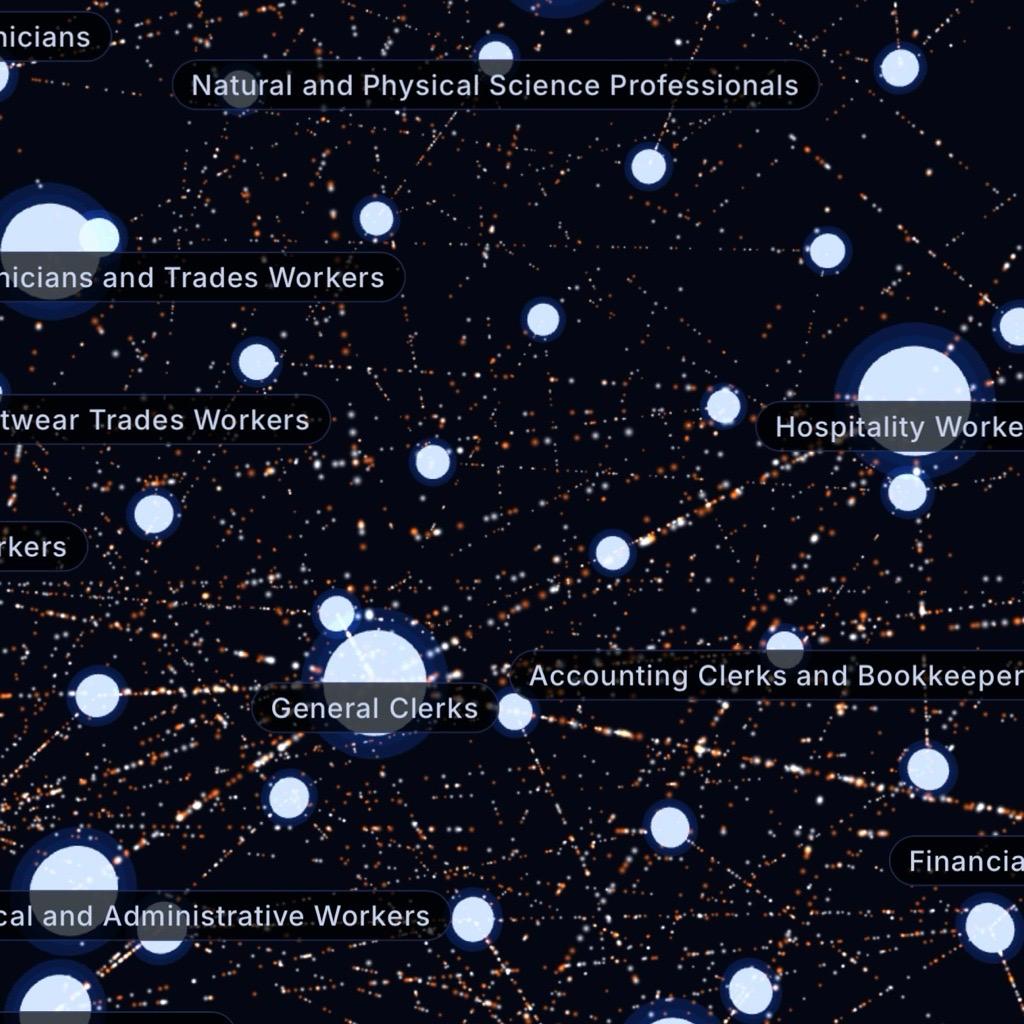
Its Predict Module adds a forward-looking perspective, using labour-market data and machine learning to project career evolution over multiple years from now.
Together, these insights can help workforce and talent teams move beyond simply asking:
How many people do we need?
Which capabilities will we need, how are they changing, and where can we find them?
The future of work is not one trend. It is a moving system. For organisations, preparing for that future means understanding how workforce demand is changing and using that insight to make better decisions today.
Plan your future workforce with better intelligence
Talk to the JobSciences team to explore how Jobography can support your future workforce strategy.
Talk to the JobSciences teamReferences
- Australian Government Treasury (2026), 2026 Intergenerational Report, Section: Major Transitions Shaping Australia's Economy.
- World Economic Forum (2025), The Future of Jobs Report 2025, Chapter 1: Drivers of Labour-Market Transformation, and Chapter 4: Workforce Strategies.
- Jobs and Skills Australia (2025), Our Gen AI Transition: Implications for Work and Skills, Generative AI Capacity Study.
- Jobs and Skills Australia (2025), Employment Projections, May 2025 to May 2030, Overview and Occupational Employment Projections.