
Where are Australia’s skills mismatches most pronounced?
To explore this question, we combine two indicators:
- Unemployment by previous occupation
- The proportion of occupations experiencing skills shortages
Using data from the Australian Bureau of Statistics, this comparison reveals four very different patterns across Australia’s occupational landscape.
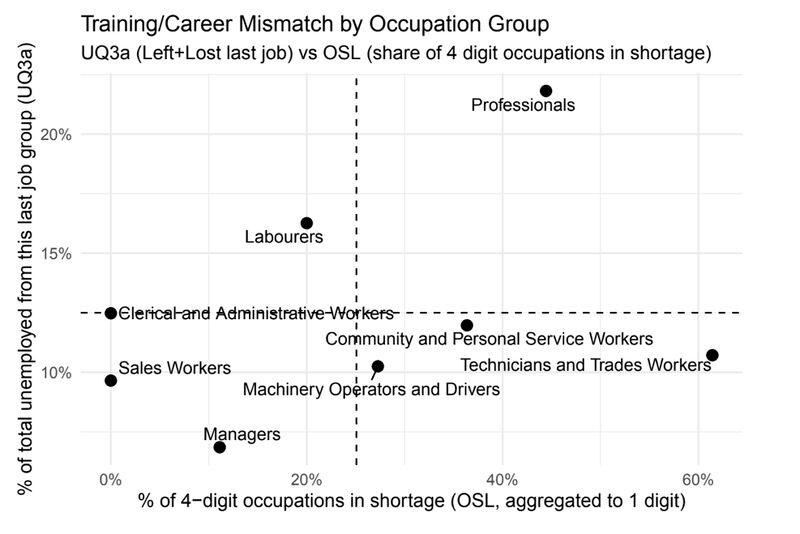
The Professional paradox: shortages and unemployment at the same time
The most striking finding appears in the top-right quadrant. Professionals have both a high shortage ratio (50%+) and a relatively high share of unemployment (around 22%). In other words, more than half of the occupations within this broad group are experiencing shortages, yet Professionals account for a substantial share of unemployed workers.
Why? It could be that the skills held by unemployed professionals may no longer align with the skills employers currently need. Mismatches could also reflect differences in geography, experience, specialisation or the relevance of existing qualifications.
This suggests that simply increasing the number of professional graduates may not solve the problem. Greater attention may need to be given to the specific skills, specialisations and career pathways connecting workers to areas of demand.
Labourers: where oversupply is more apparent
The top-left quadrant tells a very different story. Labourers have an unemployment share of around 16–17%, while only around 20% of occupations are classified as being in shortage. This combination points toward a greater risk of labour supply exceeding demand within this occupational group.
For workers whose roles are becoming less in demand, the challenge is finding a viable pathway into occupations where demand is stronger. This makes labourers an important group when thinking about retraining, reskilling and career transition programs.
Thus, higher unemployment combined with relatively few shortages suggests a stronger need for reskilling and pathways into occupations with growing demand.
Technicians and trades: a tight labour market
At the opposite end of the spectrum, the bottom-right quadrant highlights occupations where the labour market appears considerably tighter. Technicians and Trades Workers have a shortage ratio of approximately 60%, while accounting for only around 10% of unemployment.
That combination is consistent with a labour market where employers are struggling to find workers with the skills they need, while relatively few workers in this occupational group are unemployed.
Community and Personal Service Workers show a similar, although less pronounced, pattern. Around 35% of occupations are experiencing shortages, while their unemployment share is slightly below average.
The challenge here is less about redeploying unemployed workers and more about building sustainable skills pipelines into these occupations.
The middle ground: neither shortage nor oversupply
Finally, the bottom-left quadrant contains Managers, Sales Workers, Machinery Operators and Drivers, and Clerical and Administrative Workers. These groups have both relatively low shortage ratios and relatively low unemployment shares.
This suggests a more balanced labour market. There is no obvious indication of either a severe shortage or a large pool of unemployed workers relative to other occupational groups. But “balanced” does not necessarily mean “static”. Labour market conditions can change rapidly as technology, industry demand and the structure of work evolve.
In sum, the most important insight is that occupational shortages and unemployment cannot be understood in isolation. The real challenge is understanding the pathways between them.
Have a labour market question?
Looking to investigate skills, occupations, shortages or workforce transitions using ABS or Jobs and Skills Australia (JSA) data?
Talk to us about your data inquiry