
For many organisations, matching people to roles still begins with a job title. A vacancy is posted with a set of requirements, candidates are compared against them, and the person who appears to be the closest match is selected.
But job titles only tell part of the story.
Recent Australian Bureau of Statistics (ABS) data (ABS, 2026) shows that “finding a job that matches skills and experience” was rated “Very important” by 33% of the 3.2 million people who did not have a job in the March quarter of 2026, when considering factors associated with returning to or commencing work. These numbers echo recent findings from the Household Income and Labour Dynamics in Australia (HILDA) Survey showing that 49.5% of Australians aged between 18 and 64 believed they were overqualified for their current jobs (Laß, 2026).
For organisations, this raises a different question: how accurately are we matching people to opportunities in the first place?
The gap between a job title and what someone can actually do
A job title describes a position, but it does not necessarily capture the full range of skills being used within it. Deloitte’s research found that 63% of current work being performed falls outside people’s core job descriptions, while 81% of respondents said work is increasingly being performed across functional boundaries (Deloitte, 2022).
This has important implications for workforce planning. Consider an employee in a marketing role. Their title may suggest one clear function, but their experience could include campaign management, customer research, data analysis and stakeholder management. Those capabilities may also be relevant to roles in customer experience, market research or business development.
If an organisation searches only by job title, those connections can easily remain invisible.
That can mean external hiring for roles where relevant capability already exists internally, limited redeployment options during organisational change, or succession planning based on titles rather than capability.
Why skills are becoming harder to plan for
The challenge becomes even greater as the skills attached to roles continue to change.
The World Economic Forum’s Future of Jobs Report 2025 found that employers expect 39% of workers’ existing core skills to change by 2030. The report also identified skills gaps as the biggest barrier to business transformation, with 63% of employers citing them as a major constraint.
For organisations, this means that understanding today’s workforce is no longer enough. Workforce planning needs to consider what skills employees have now, where those skills could be applied, and how the requirements of different roles are likely to evolve.
Deloitte’s research points to a similar shift. Fewer than one in five organisations have adopted skills-based approaches to a significant extent, while 85% of HR executives say they are planning or considering redesigning how work is organised so that skills can be used more flexibly. The direction is clear: organisations are moving towards understanding capability rather than relying solely on job definitions.
Making the connections visible
This is where occupational and skills intelligence can become valuable. With our Skills Explorer (see image below), organisations and their employees can explore what skills, technologies and tasks are attached to their current roles and how these differ from the average tasks or skills required for their jobs.
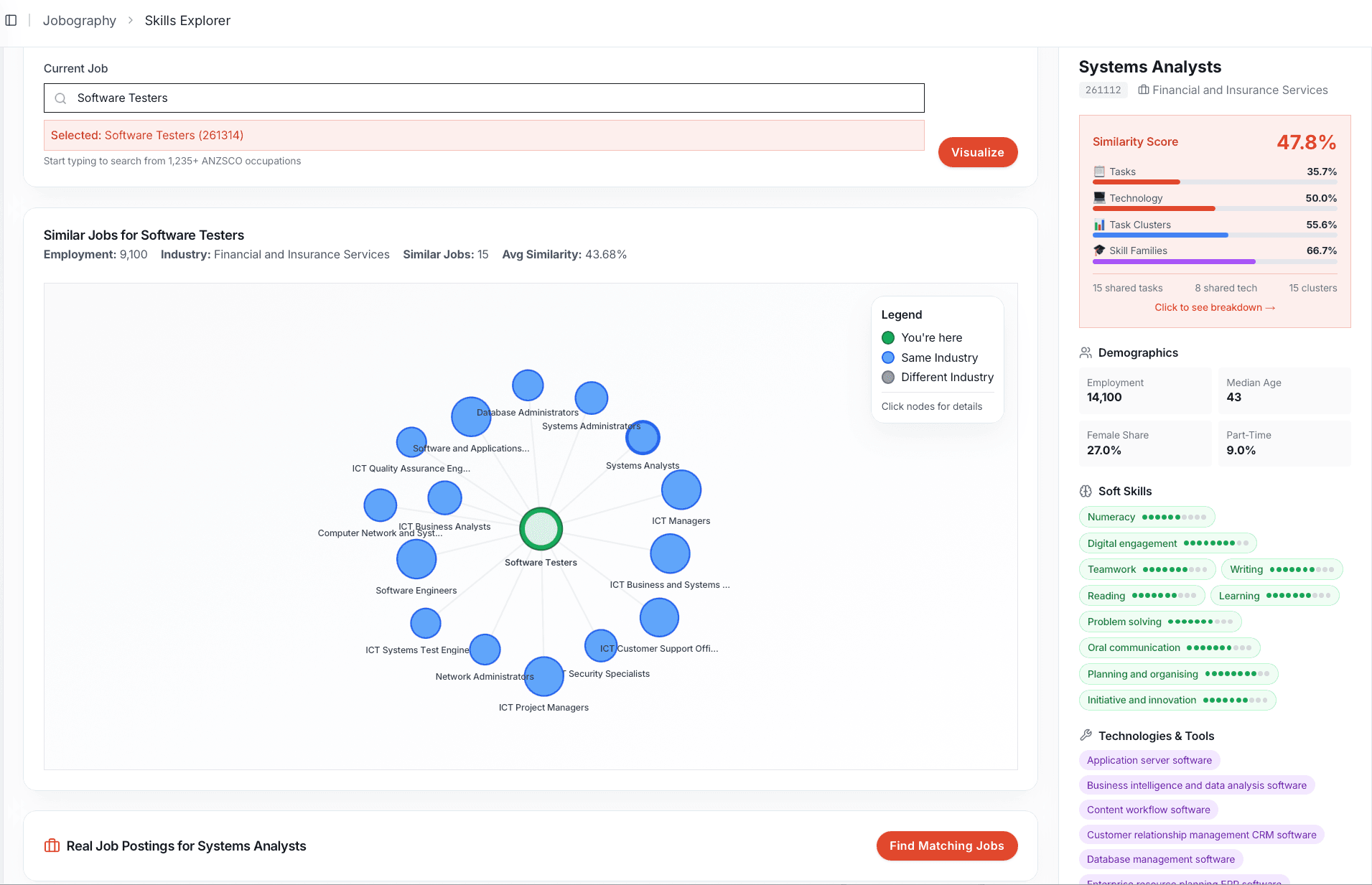
Jobography’s approach is built around mapping the relationships between occupations, skills and industries, helping organisations see connections between roles that may appear unrelated when viewed only through their titles. Its occupational intelligence can support workforce decisions by providing greater visibility into potential talent pools and relationships across the labour market.
For an enterprise, that visibility can support several decisions:
- Identifying internal candidates before opening an external search
- Finding potential redeployment options during restructuring
- Building broader succession pipelines
- Understanding where existing capabilities may align with changing workforce needs
The benefit is not simply finding more candidates. It is making better-informed decisions about where capability already exists and where it could be used next.
Planning beyond today’s workforce
A skills-based view also needs to look beyond the current workforce. If 39% of core skills are expected to change by 2030, organisations need to understand not only what their people can do today, but how roles and skill requirements are changing around them.
By bringing labour-market data and occupational intelligence together, JobSciences can help workforce and talent teams understand these changes in context—supporting decisions around hiring, redeployment, talent development and future workforce planning.
The challenge is no longer simply filling a vacancy. It is understanding whether the right capability already exists, where it can be found, and how it can support the organisation as work continues to change.
For organisations looking to reduce hiring risk, make better use of internal capability or plan for changing skill requirements, talk to the JobSciences team about how Jobography’s occupational intelligence can support your workforce strategy.
Contact the JobSciences teamReferences
- Australian Bureau of Statistics (ABS), Barriers and Incentives to Labour Force Participation, Australia, March 2026, reference period March 2026, Table Q7: Incentives to work.
- Laß, Inga (2026), “Many Australians are overqualified for their jobs—which comes at a price, new data shows”, The Conversation.
- World Economic Forum (2025), The Future of Jobs Report 2025, Chapter 4: Workforce Strategies, Section 4.1: Barriers to Transformation.
- Deloitte Insights (2022), Skills-based organizations, Deloitte Development LLC.